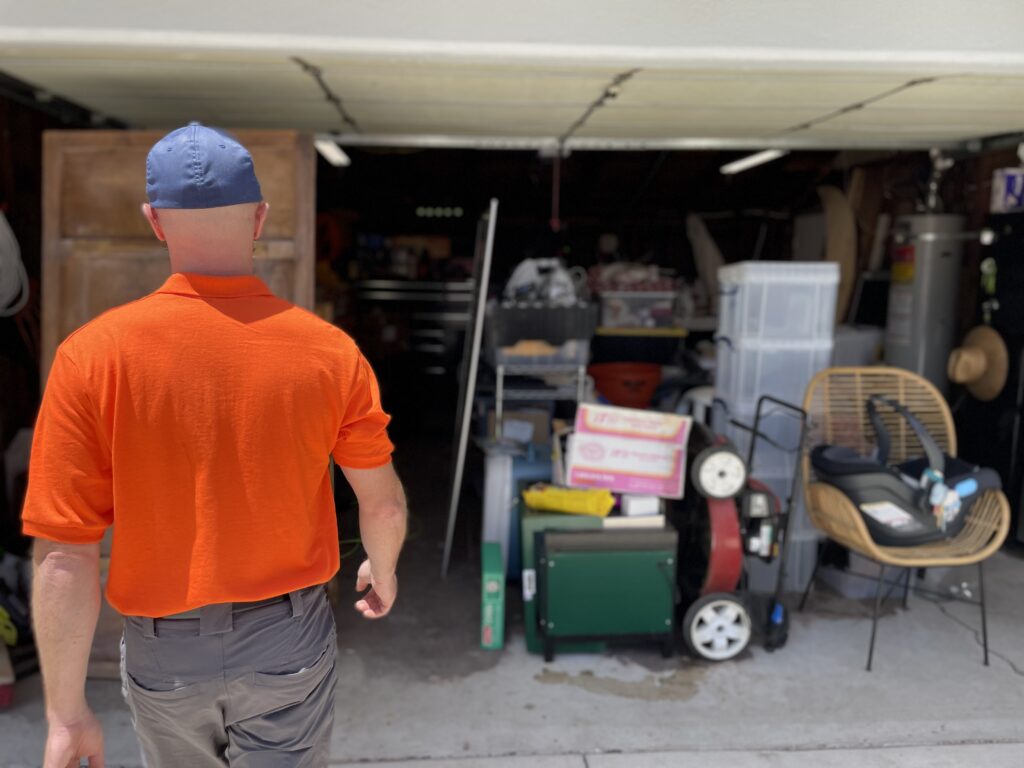
I'll tell you what I tell every customer who apologizes when I walk into their garage:
You're not a hoarder. You're a person. There's a difference.
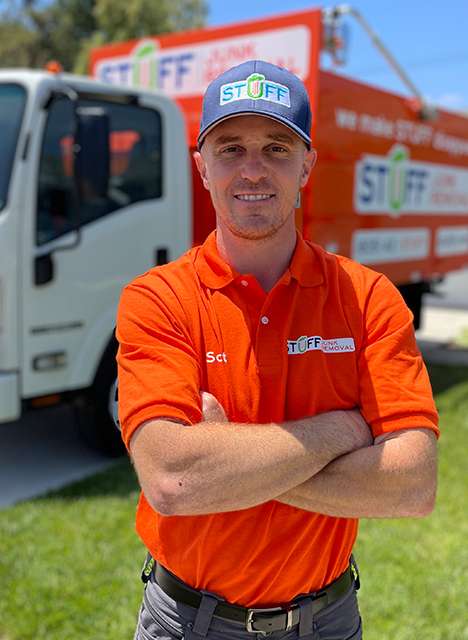
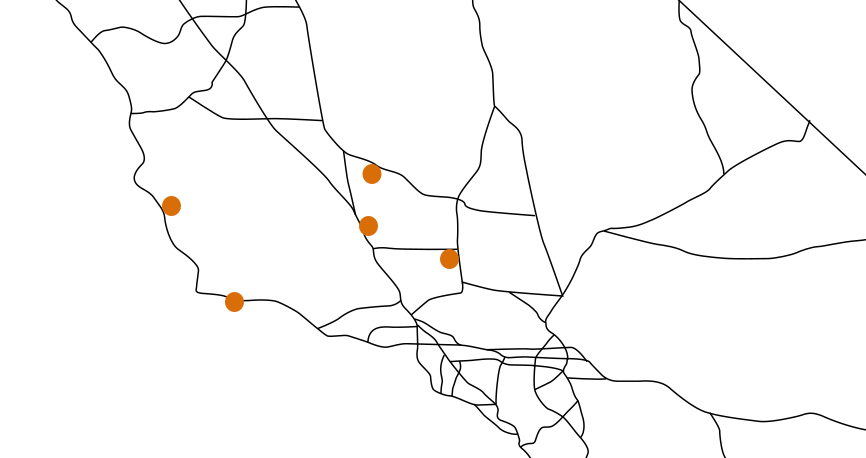
I own a junk removal company. I've been inside hundreds of garages, basements, sheds, side yards, and storage units across the Conejo Valley. The number of people who open the door and say some version of "sorry, it's bad" is close to 100%. They think we're going to judge them. We're not. We've seen worse. We've seen everything.
But the shame is real, and it's worth talking about — because I think most people are carrying it for the wrong reason.
Every human being is a hoarder. A little bit.
I joke about this on every job. Every one of us has stuff we hang onto for irrational, emotional reasons. The shirt from a trip. The toolbox you inherited. The kids' art from the year they were three. The thing your dad gave you that you'd never actually use, but you can't throw out either.
That's not a disorder. That's being human. Possessions are how we mark time. They're how we remember what mattered. The fact that they pile up isn't a moral failing — it's the natural result of living a life and caring about things.
So let's get the shame out of the way first. You're not broken. You're not lazy. You don't need a self-help book. You just need someone to back a truck up to your house.
The math is rigged against you.
Here's the part nobody talks about: the entire economy is built to sell you more stuff than you can possibly get rid of on your own.
Amazon delivers in a day. Costco sells in bulk. Target's whole strategy is making it cheap and easy to walk out with three things you didn't come in for. Every commercial, every algorithm, every shopping cart in your phone is engineered to put more stuff in your house.
And nobody — nobody — is engineering the other side of that equation. There is no algorithm that helps you get rid of stuff. There's no notification that says "you bought a new blender last month, time to throw out the old one." The accumulation is automatic. The removal is manual.
If you don't get rid of one thing every time you bring one in, you accumulate. That's not a personal failure. That's just math.
The cost isn't just the stuff.
The hardest part of stuff isn't the buying. It's everything that comes after.
You have to organize it. You have to clean around it. You have to move it when you need to get to the thing behind it. You have to fix the things that broke. You have to remember which box has the Christmas lights. You have to feel a little bit bad every time you walk past the corner of the garage where the "I'll deal with that someday" pile lives.
That's the real tax. Not the money you spent — the headspace it occupies. The low-grade hum of "I should really do something about that."
Most of our customers don't call us when their garage gets full. They call us when they get tired of thinking about it. The garage was full a year ago. What changed is that they hit the wall.
My side yard is full. I own a junk removal business.
I'm not exempt from any of this. I love tools. I love the idea of projects. I look at a piece of weird wood and think "I bet I could turn that into something."
My side yard is full. I can't park in my own garage. I'm 36, I run a junk removal company, and I have the same problem as everyone else.
I'm telling you this because if anyone should be immune, it's me. I haul this stuff away for a living. And I still struggle with it.
The point isn't "shame on me." The point is: this is normal. The accumulation is the default. Doing something about it is the choice.
The shame goes away the second the stuff does.
This is the part I wish more people knew before they called us.
The relief is faster than you think. We pull up. You point. We work. An hour later, the corner of your house that you've been avoiding for two years is empty. Clean. Done. You walk out into the garage and it doesn't talk to you anymore.
That feeling — the silence where the guilt used to live — is what you're actually paying for. The hauling is the easy part. The relief is the product.
Nobody should feel ashamed of their stuff. But you're allowed to acknowledge it's a burden. And you're allowed to call someone to take it.
We're not here to judge. We're here to haul. (See how we price it.)
Ready to stop thinking about it?
Call or text 805-427-8833. We give you an exact price before we touch anything. If it works, we knock it out right then. If it doesn't, no obligation, no awkward goodbye.
STUFF. Gone.